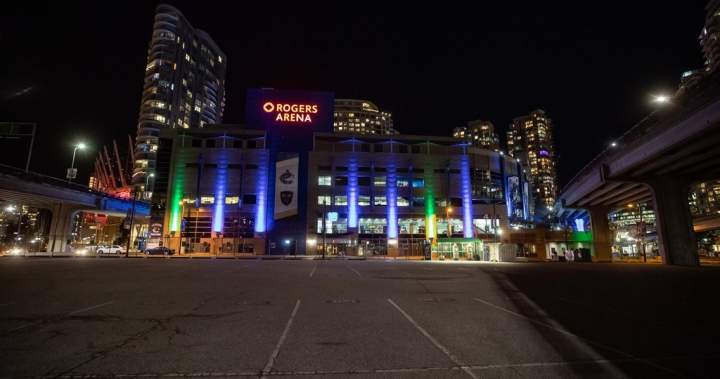
The NHL will have a new challenge in setting its 2026-27 schedule with British Columbia switching to permanent year-round daylight saving time this fall and Alberta expected to follow suit.
This change will eliminate the twice-yearly clock changes in these provinces. The time gap between BC and Alberta and parts of Canada that still turn back the clock on November 1 will then shrink by one hour.
Game times for sporting events could be affected, as could long-standing traditions such as hockey doubles.
“We’ll deal with it,” NHL commissioner Gary Bettman said Tuesday before Game 1 of the Stanley Cup final in Raleigh, N.C. “It may impact some starting times in Calgary, Edmonton and Vancouver.
“But we will face it just as we face anything we cannot control.”
The NHL typically releases its schedule in mid-July. Regular season play typically begins in early October.
“Hockey is still a big attraction,” said Chris Zelkovich, an instructor at the Toronto-based College of Sports Media. “But if you put obstacles in the way of people like starting games at (different or) inappropriate times, you will lose the audience.”
Related Videos

While there are exceptions, Canadian teams based in the Eastern time zone – the Toronto Maple Leafs, Montreal Canadiens and Ottawa Senators – typically start their home games at 7 p.m. local time.

Get daily National news
Get Canada’s daily news stories delivered to your inbox so you never miss the day’s top stories.
This has previously set times for doubleheaders with teams based in Alberta and BC – the Calgary Flames, Edmonton Oilers and Vancouver Canucks – that are typically two or three hours later than ET.
Trimming the one-hour time difference may require some strategic scheduling. There could be overlapping games, or we could see a later start time in the west to protect the TV window in sequence.
“It’s going to be a big adjustment,” Zelkovich said of the potential change. “And if your team is a Stanley Cup contender, that might not be a problem.
“But if you don’t, you’ll probably say to yourself, ‘Well, there’s no point (to watching it).’”
The Winnipeg Jets are in the Central Time Zone, one hour behind ET.
A lost hour will also be felt when the Flames, Oilers and Canucks play road games along the US West Coast. For example, if the puck drops around 9:30 p.m. Alberta time, the game may not finish until after midnight in that province.
“Ensuring hockey games remain accessible to fans in Oil Country is our priority,” Oilers president and chief revenue officer Stew MacDonald said in an email. “And any change that results in later start times for games is a concern – especially as this creates challenges for families and young fans attending games or watching live broadcasts.”
The Flames declined to comment, while the Canucks did not return messages.
When asked for comment, a Sportsnet spokesperson said the league sets the schedule and start times. A TSN spokesperson said the network had nothing to share.
“I don’t think this fundamentally changes their business,” said Mike Naraine, a sports management professor at Brock University. “It might, from an advertising standpoint, cause (broadcasters) a little more (work).
“It’s not a problem, but just another problem that they just solved.”
The CFL, which has nine teams across the country, also uses regular doubleheaders. The regular season ends on Oct. 24, so the league won’t be affected as much this year.
With files from Canadian Press sports reporters Donna Spencer, Joshua Clipperton, Gemma Karstens-Smith and The Associated Press.
This report by The Canadian Press was first published June 2, 2026.
© 2026 Canadian Press
PakarPBN
A Private Blog Network (PBN) is a collection of websites that are controlled by a single individual or organization and used primarily to build backlinks to a “money site” in order to influence its ranking in search engines such as Google. The core idea behind a PBN is based on the importance of backlinks in Google’s ranking algorithm. Since Google views backlinks as signals of authority and trust, some website owners attempt to artificially create these signals through a controlled network of sites.
In a typical PBN setup, the owner acquires expired or aged domains that already have existing authority, backlinks, and history. These domains are rebuilt with new content and hosted separately, often using different IP addresses, hosting providers, themes, and ownership details to make them appear unrelated. Within the content published on these sites, links are strategically placed that point to the main website the owner wants to rank higher. By doing this, the owner attempts to pass link equity (also known as “link juice”) from the PBN sites to the target website.
The purpose of a PBN is to give the impression that the target website is naturally earning links from multiple independent sources. If done effectively, this can temporarily improve keyword rankings, increase organic visibility, and drive more traffic from search results.