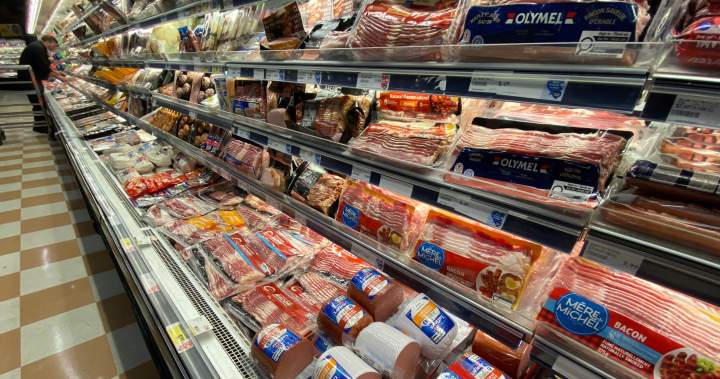
Canadians may see their grocery bills slightly higher as food suppliers warn grocers that they will impose fuel surcharges on deliveries to grocery stores.
Global News has obtained notices sent by Canada’s three largest food suppliers to their grocery customers – first reported by CBC News – informing them of the surcharges.
Maple Leaf Foods sent a letter to its clients on March 31st, informing them that they would begin charging fuel surcharges starting April 6th.
Citing “developments in the Middle East” and “sharp increases in crude oil prices, which have resulted in rapid and significant increases in fuel costs,” the company said it would add a temporary fuel surcharge of $0.11 per kg to all shipments of processed meat and fresh poultry.
“This is not a permanent price increase, but rather a temporary adjustment directly related to fuel price movements,” the company said in its letter.
“We are not using this mechanism to reverse other inflationary pressures such as raw materials, packaging or materials,” he added.
Tree of Life, in a letter dated March 23, said they would add a $10 fuel surcharge per delivery starting April 22.
Tree of Life said higher fuel prices “have resulted in continued increases in diesel fuel costs, which directly impacts our logistics and distribution operations.”
However, the company said it would waive the surcharge if diesel costs returned to the three-month average of $1.20 per liter or lower.
According to GasBuddy, the average diesel price in Canada was $1.78 per liter on Wednesday.

Some food suppliers are also increasing their minimum order requirements.
Ontario-based meat supplier Brandt Meats told clients it will increase the minimum order requirement to $1,000 for all deliveries starting May 4, according to one letter obtained by Global News.
“Rising fuel and labor costs have significantly increased transportation costs across our industry. Until now, Brandt Meats has covered these additional costs to minimize the impact on our customers. Unfortunately, we can no longer fully offset these increases and have had to adjust our delivery needs,” the company said.
Sobeys has received requests for fuel surcharges from wholesalers and said they would refuse to pay them, according to an emailed statement.
“We have received several requests from suppliers to date, but we have declined them,” a Sobeys spokesperson said.

Get the latest national news
Get the latest Canadian news delivered to your inbox so you never miss a trending story.
“Similar to our approach to rates last year, we believe the fuel market is unpredictable enough to make any decisions that could adversely impact the value we provide to our customers,” they added.
Loblaw said it “has regular dialogue with our suppliers and continues to review fee increase applications,” including regarding fuel surcharges.
The company said in a statement that it would “reject unjustified cost increases, including fuel surcharges where unjustified,” but did not say under what circumstances it considered the cost increases to be justified.
Metro said it “carefully reviews and negotiates supplier requests to ensure they are justified and limit their impact on our customers, while continuing to offer competitive pricing,” without adding further details about what makes a request justified.
However, small and independent merchants are concerned that they will not have the option to resist any fee increases.
“It’s troubling for us to hear that these additional costs and the impact of rising fuel prices will not be shared equally across the retail sector. Smaller independent grocery stores certainly don’t have the leverage that some of the larger chains do,” said Gary Sands, senior vice-president of the Canadian Federation of Independent Grocers.
Communities in northern and rural areas, as well as urban food deserts, will be most significantly impacted by rising food prices, which will be passed on to consumers, Sands said.
“In the grocery retail business, you have very tight margins. Independent companies, in a good year, operate on an overall margin of about two percent. If you have fuel surcharges … and trucking costs go up 40 to 50 percent, there’s no way you can avoid passing that on to your customers,” he added.

Adding fuel surcharges to delivery costs is “a legitimate thing,” says University of Guelph food economist Mike von Massow, and some suppliers even build them into their contracts with clients.
“Even if it’s not part of the contract, the freight rate goes up and they pass on it. Actually, it’s better for them to make a temporary surcharge rather than a permanent price increase,” he added.
In Canada, companies are generally free to set the prices at which they sell their products, the Competition Bureau says, as long as those prices do not amount to price gouging.
“Only the provinces and territories have regulations regarding price gouging in Canada,” the bureau said in a statement.
The Business Competition Bureau enforces the Business Competition Law, which includes provisions prohibiting “illegal practices such as price fixing, competitor collaboration, misleading advertising, and abuse of dominant position.”
The bureau did not say whether this was being considered, as it is required by law to conduct its work independently.
“The Bureau must conduct a thorough and complete examination of any facts before coming to a conclusion as to whether the Competition Law has been violated,” he added.
The fuel surcharge “is not surprising,” said Conservative MP Sandra Cobena.
“It doesn’t take a genius to realize that this ultimately wipes out the savings that the excise tax suspension that the prime minister announced yesterday would have provided Canadians,” Cobena said.
“We are proposing that all federal taxes be eliminated for the remainder of the year. If we can pass that plan, then there will actually be some relief for Canadians,” he added.
Fuel surcharges will make it difficult for Canadians to buy groceries, the federal NDP says.
“Now food suppliers are threatening to pass on fuel surcharges to retailers, which will be passed on to consumers. Small businesses are being forced to raise prices or eat into their profits while big oil companies continue to rake in billions in excess profits,” NDP MP and the party’s critic for agriculture and small business Gord Johns said.
PakarPBN
A Private Blog Network (PBN) is a collection of websites that are controlled by a single individual or organization and used primarily to build backlinks to a “money site” in order to influence its ranking in search engines such as Google. The core idea behind a PBN is based on the importance of backlinks in Google’s ranking algorithm. Since Google views backlinks as signals of authority and trust, some website owners attempt to artificially create these signals through a controlled network of sites.
In a typical PBN setup, the owner acquires expired or aged domains that already have existing authority, backlinks, and history. These domains are rebuilt with new content and hosted separately, often using different IP addresses, hosting providers, themes, and ownership details to make them appear unrelated. Within the content published on these sites, links are strategically placed that point to the main website the owner wants to rank higher. By doing this, the owner attempts to pass link equity (also known as “link juice”) from the PBN sites to the target website.
The purpose of a PBN is to give the impression that the target website is naturally earning links from multiple independent sources. If done effectively, this can temporarily improve keyword rankings, increase organic visibility, and drive more traffic from search results.